A Behavioural Science Approach to Understanding Home Energy Label Adoption in Canada
Impact Canada, Impact & Innovation Unit, Privy Council Office
Key Insights
- Canadians face various barriers to adopting home energy labels, including overconfidence about their home’s energy performance and lack of awareness of the EnerGuide for Homes label.
- Of the different kinds of information that might be included on a home energy label, Canadians are particularly interested in information about how they can save money through energy efficiency upgrades.
- Prospective homebuyers rated home energy labels as more important than did current homeowners, highlighting time-of-sale as a key window of opportunity to increase label adoption.
- Experimental findings suggest that light-tough communications alone are unlikely to boost label adoption; higher engagement strategies are likely needed.
Background
The Government of Canada’s Emissions Reduction Plan aims to mitigate the impacts of climate change by significantly reducing greenhouse gas (GHG) emissions by 2030, and reaching net-zero emissions by 2050. In Canada, homes and buildings are responsible for 13% of national GHG emissions from the combustion of fossil fuels alone. Electricity use for cooling, lighting, and appliances brings the total to 18%. For Canada to reach its emissions reduction targets, new homes will need to be designed to be energy efficient, and existing homes will need to be retrofitted to improve their energy efficiency (e.g., switching to more efficient heating and cooling systems, improving insulation, etc.).
The EnerGuide Rating System (ERS) for homes, implemented by Natural Resources Canada (NRCan), is one of many policies and programs that aim to accelerate home energy retrofits and ensure that new homes meet the highest standards. The program was first launched in 1998 and since then it has served as the Canadian standard for home energy evaluation and labelling. The EnerGuide for Homes rating and label (Figure 1) are intended to help Canadians better understand their home’s energy performance so they can make informed decisions when purchasing, selling, or renovating their home. The process for obtaining an EnerGuide label involves an on-site evaluation conducted by an energy advisor where they measure and collect data about the various elements of the home that may affect its energy use. Following the evaluation, homeowners receive a label and report that summarize various aspects of the home’s energy performance, including its energy consumption relative to a typical new home, as well as a list of recommended retrofits that can be undertaken to improve energy efficiency.
Figure 1. Sample EnerGuide for Homes Rating and Label

Text version
Learn about your home’s energy rating: You will receive a rating of the home’s energy consumption in gigajoules
Compare your home’s Performance: The label shows how your home’s performance compares to a benchmark home
Aim towards Zero: The lower the number on the new EnerGuide scale, the better the energy performance of your home
Find out where most energy is consumed: The label shows proportion of energy consumed by heating, cooling, ventilation, etc.
Understand how to use energy: The label breaks down energy consumed by source
See your impact on the environment: The label shows your home’s Greenhouse Gas Emissions
Home energy labels provide important information about the energy performance of a home, which can help to increase homeowners’ energy literacy and support their decision-making. However, the current process for getting a label is both lengthy and expensive, which creates barriers to uptake. Indeed, only about 12% of eligible homes in Canada have an EnerGuide label.
The purpose of this study was to identify ways to increase home energy label adoption in Canada. More specifically, we aimed to address two questions: 1) What are the main drivers and barriers of home energy label adoption? 2) Can we increase the perceived importance of getting an EnerGuide for Homes label using behaviourally-informed communications?
Methodology
We recruited 2,731 Canadians – representative of the Canadian population by region, age, and gender – to complete an online study. This study was administered through Qualtrics, which is an online survey platform that recruits from existing pools of participants who have agreed to be contacted for research studies. Respondents were only eligible to participate if they were a current homeowner with no intention to sell, a prospective home seller (i.e., a homeowner who intended to sell their home within the next two years), or a prospective homebuyer (i.e., a non-homeowner who intended to buy a home within the next two years). Data were collected in March 2023 in both official languages (English and French).
In the first part of the survey, respondents answered a series of questions assessing their general knowledge of their home and its energy use, the perceived importance of adopting an EnerGuide for Homes label, and various self-reported drivers and barriers to adopting a label.
In the second part of the survey, respondents were randomly assigned to view one of six behaviourally-informed communications about the EnerGuide label (see below). Five of the messages were based on potential drivers and barriers to adopting a home energy label: (1) appealing to people’s pro-environmental identity (green message), (2) appealing to social norms (social norm message), (3) describing the benefits of the label (value message), (4) describing how to get a label (processing steps message), and (5) a combination of these four (combined message). The sixth message provided general information about the EnerGuide label (control message), establishing a baseline against which to test the effects of the other messages. After viewing their assigned message, respondents were asked how important getting a home energy label was to them.
This study and its analysis plan were pre-registered on the OECD Observatory of Public Sector Innovation Behavioural Insights Knowledge Hub prior to completing data collection.
Experimental and control messages shown to survey respondents
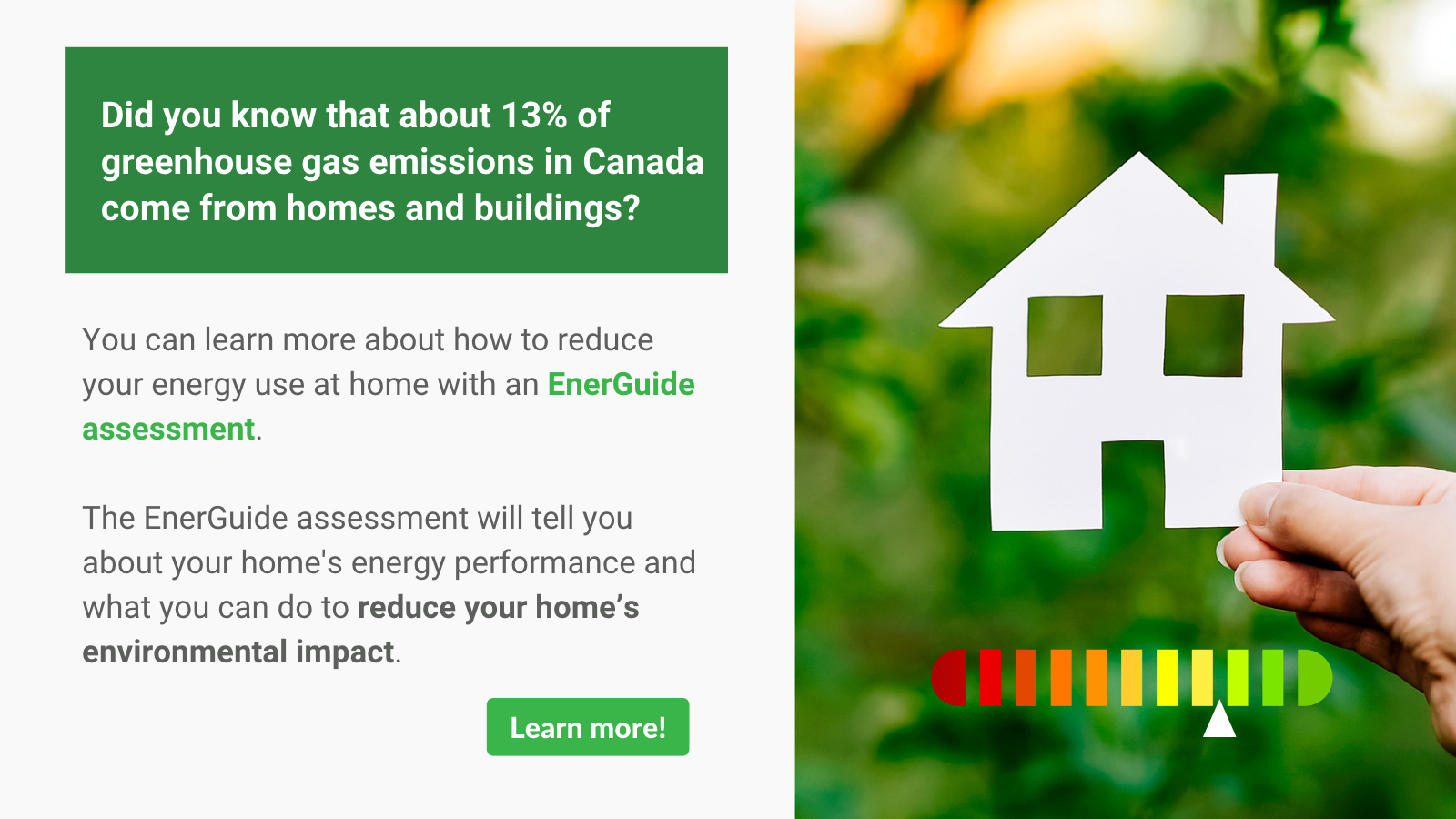
1. Green
This message appealed to people’s pro-environmental identity by linking the home energy label to environmental benefits.

2. Social norm
This message emphasized that many other people have already gotten an EnerGuide label for their home.
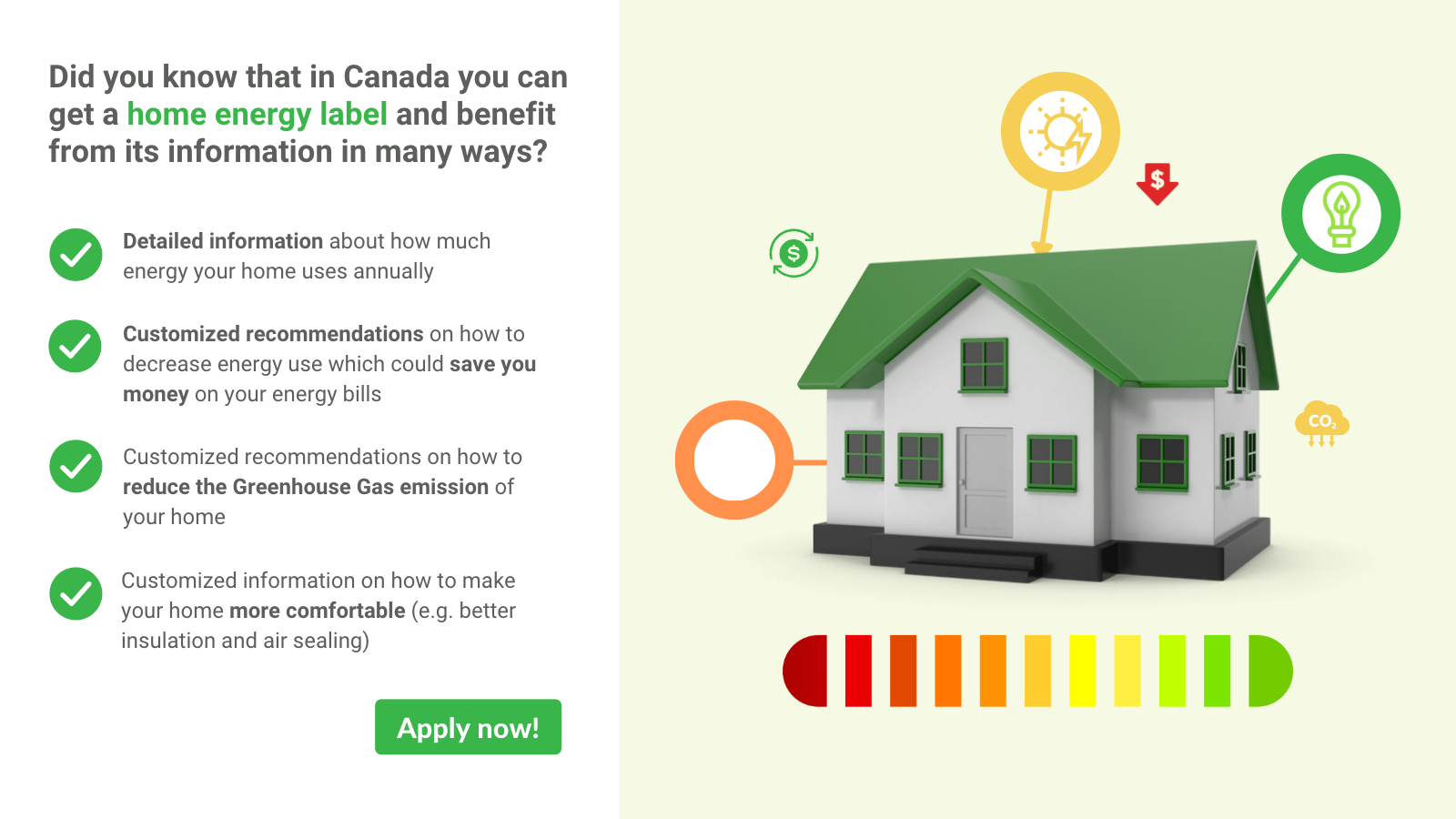
3. Value
This message highlighted the value of the home energy label by describing its potential benefits.

4. Processing steps
This message clarified the process of getting a home energy label by providing step-by-by-step instructions.
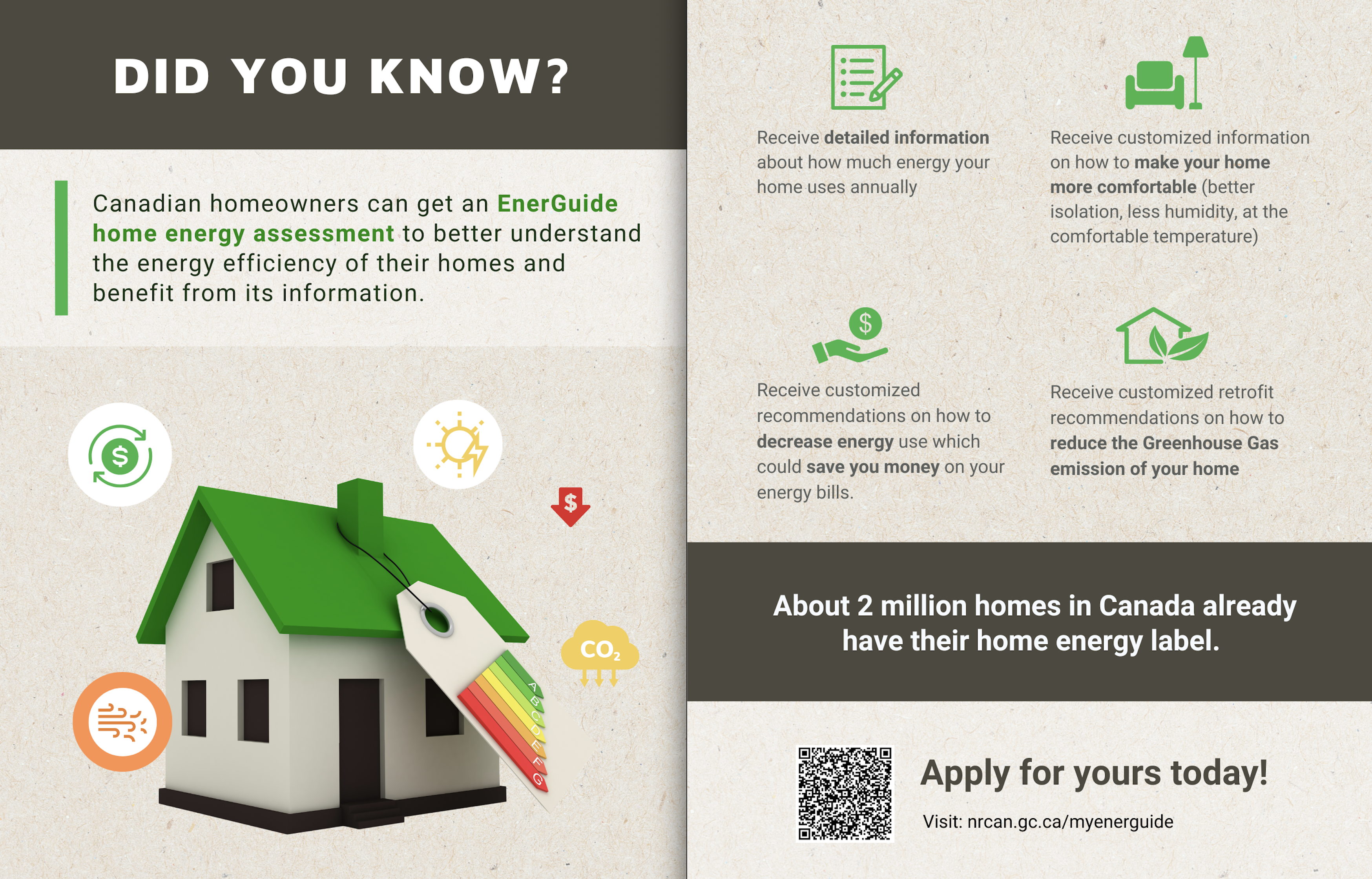
5. Combined
This message was a combination of the green, social norm, value, and processing steps messages.

6. Control
This message provided general information about getting a home energy label, establishing a baseline against which to test the effects of the other messages.
Findings
Canadians may overestimate their home’s energy performance
Most respondents (70%) believed they were already knowledgeable or very knowledgeable about their home’s energy usage. When asked to rate their home’s energy efficiency, most respondents indicated that their home was energy efficient, with 72% scoring their home above five on a ten-point scale (Figure 2). Three quarters of respondents (77%) also rated their home's energy use as equal to or lower than similar homes, with only 12% rating their home’s energy use as higher than similar homes. This suggests an overconfidence in perceived home energy performance, such that people tend to think that their home is already performing better than average, which may limit motivation to further increase their home’s efficiency.
Many Canadians are not familiar with the EnerGuide for Homes label
Fewer than half (43%) of respondents had seen an EnerGuide for Homes label prior to the study, and only 11% had heard of someone they know getting a label in the past year. Additionally, most respondents thought of home energy labels as uncommon; around three quarters (73%) of respondents estimated that fewer than 50% of the households in their neighborhood had a label.
Desirable information for a home energy label
Respondents were asked to choose three kinds of information about home energy use that they think would be important to them. Across all ownership statuses (i.e., homeowners, home sellers, and homebuyerss), respondents were most interested in information about the potential cost-savings from energy-related upgrades (Figure 3). Highlighting financial benefits could be a driver of label adoption. Homebuyers and sellers were especially interested in how their homes compare to others, suggesting a key motivation.
Certain individual characteristics and beliefs are associated with the perceived importance of getting a home energy label
We used a multivariate regression model to reveal the factors that were most strongly related to the perceived importance of getting a home energy label. We included the following drivers and barriers in the model: self-reported knowledge of home’s energy use, familiarity with the EnerGuide for Homes label, perceived value of an energy-efficient label, perceived social norms, understanding of the rating on the label, self-reported home energy efficiency, self-reported home energy use compared to others, level of ease of processing steps to get the home energy label, pro-environmental identity, general home knowledge and ownership status (homeowner, home seller or homebuyer). We also controlled for various demographic characteristics of the sample (i.e., age, province, community type, gender, ethnicity, education, employment status, annual income).
We found that being a homebuyer or seller, having a pro-environmental identity, and perceiving home energy labelling as normative (i.e., more common) were the strongest statistically significant predictors of perceived label importance (Table 1). Perceiving an energy-efficient label as more valuable on the real estate market, and thinking it was easy to get a label, were also significant, though weaker, predictors of label importance. We did not identify any statistically significant negative predictors of perceived label importance.
Table 1. Predictors of Perceived Label Importance
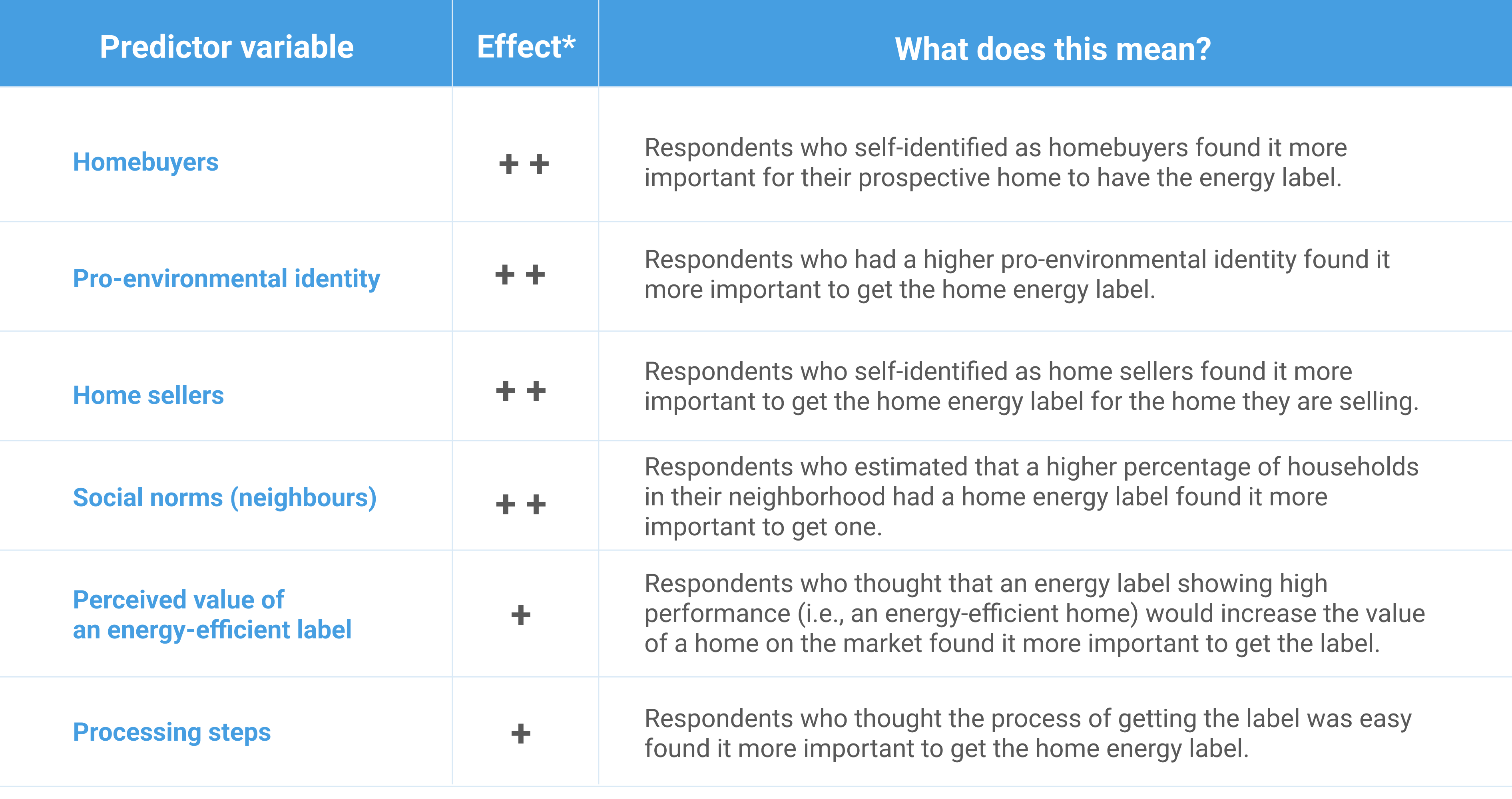
"++" symbolizes a strong positive effect (standardized beta > 0.15), and "+" symbolizes a moderate positive effect (standardized beta ≤ 0.15)
Text version
"++" symbolizes a strong positive effect (standardized beta > 0.15), and "+" symbolizes a moderate positive effect (standardized beta ≤ 0.15)
| Predictor variable | Effect* | What does this mean? |
|---|---|---|
| Homebuyers | ++ | Respondents who self-identified as homebuyers found it more important for their prospective home to have the energy label. |
| Pro-environmental identity | ++ | Respondents who had a higher pro-environmental identity found it more important to get the home energy label. |
| Home sellers | ++ | Respondents who self-identified as home sellers found it more important to get the home energy label for the home they are selling. |
| Social norms (neighbours) | ++ | Respondents who estimated that a higher percentage of households in their neighborhood had a home energy label found it more important to get one. |
| Perceived value of an energy-efficient label | + | Respondents who thought that an energy label showing high performance (i.e., an energy-efficient home) would increase the value of a home on the market found it more important to get the label. |
| Processing steps | + | Respondents who thought the process of getting the label was easy found it more important to get the home energy label. |
Effect of Behaviourally Informed Messages on the Perceived Importance of Label Adoption
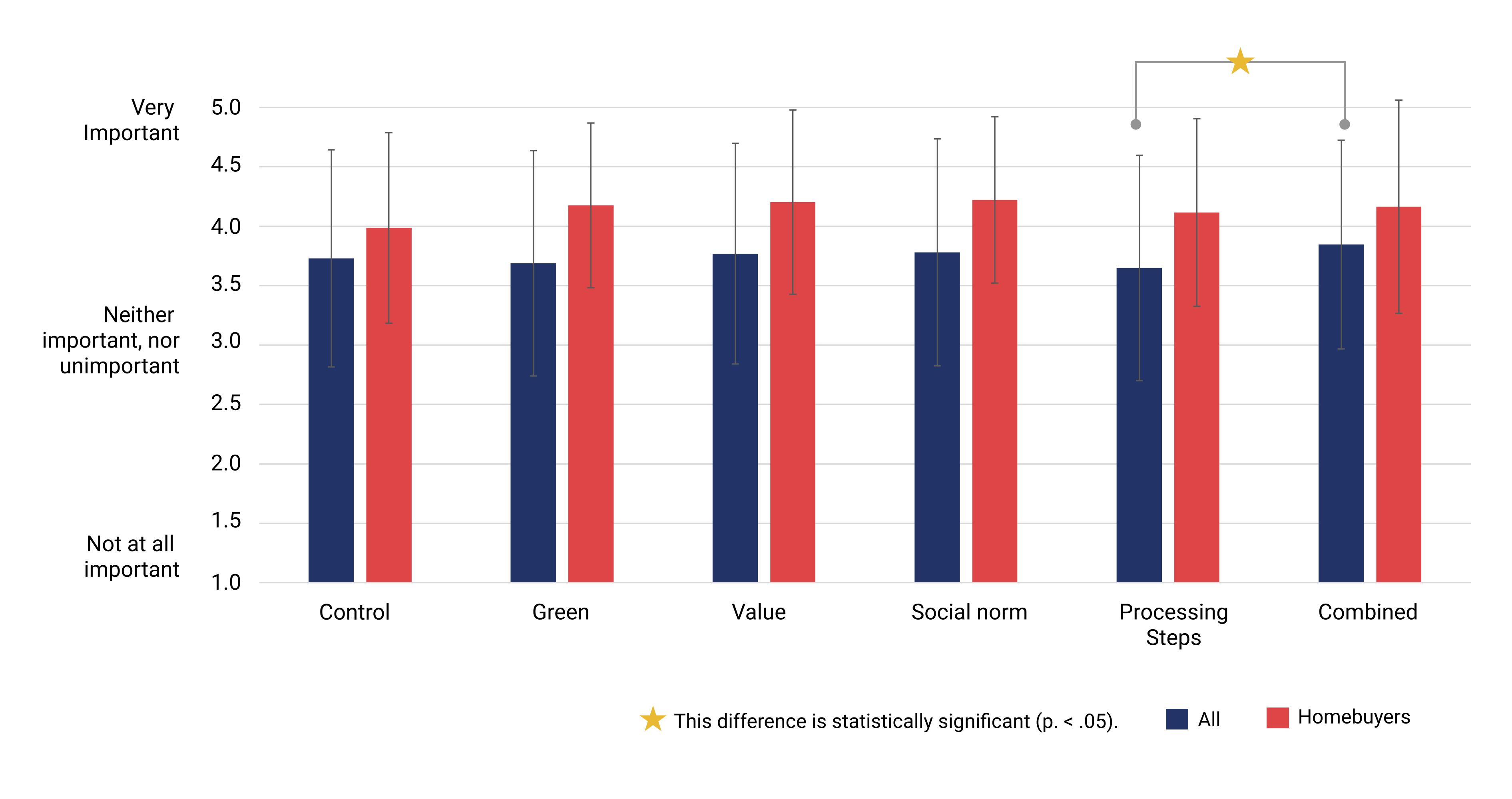
Overall, none of the behaviourally informed messages increased the perceived importance of getting a home energy label compared to the control message (general information about home energy labels) (Figure 4). However, respondents who saw the combined message rated getting a home energy label as significantly more important than did those who saw the processing steps message.
Irrespective of message, homebuyers rated getting a home energy label as more important than did home sellers and homeowners, suggesting that ownership status impacts individuals’ perceptions of the label. Time of sale may provide an important window of opportunity to boost adoption, given the heightened importance prospective buyers place on home energy labels.
Figure 4. Perceived Importance of Getting a Label After Viewing Different Messages
Survey respondents were asked: “To what extent would it be important or not important to get a home energy label for your home/ a home you would consider buying/ a home you want to sell.” None of the behaviorally informed messages significantly increased the perceived importance of getting a home energy label compared to the control message. Across all messages, the perceived importance of getting a label was higher among homebuyers. Note: error bars represent +/- 1 standard deviation.
Text version
| Condition | All | Homebuyers |
|---|---|---|
| Control | 3.73 | 3.99 |
| Green | 3.69 | 4.18 |
| Value | 3.77 | 4.20 |
| Social norm | 3.78 | 4.22 |
| Processing steps | 3.65 | 4.12 |
| Combined | 3.85 | 4.16 |
Discussion
Home energy labels can help homeowners better understand the energy performance of their home and make informed decisions when buying, selling, or renovating. However, adoption of home energy labelling remains low. These findings suggest that while Canadians generally think home energy labelling is important, various barriers to adoption may be contributing to the low levels of uptake. Many Canadians already perceive their home to be energy efficient and think that their home uses less energy than other similar homes, even when this may not be the case. These perceptions may be reducing interest in getting the EnerGuide for Homes label, since people may not be motivated to seek out information if they think themselves knowledgeable and believe that their home is better than average. Canadians also lack awareness of the EnerGuide for Homes label, which is critical for increased adoption. To get a home energy label, people must first know that they exist. In addition, Canadians do not think these labels are common, which may demotivate them. On the other hand, Canadians are particularly interested in information about the cost-savings that could be realized through home upgrades, which appears to motivate them to learn about home energy use and retrofits. Highlighting financial gains could therefore help to increase interest in labelling and drive label adoption.
None of the behaviourally informed messages had a statistically significant impact on the perceived importance of getting a home energy label, compared to the control condition (general information about labels). This suggests that light-touch communications alone are unlikely to meaningfully boost label adoption and that higher-engagement strategies, such as those that directly address structural barriers to label adoption, like cost and accessibility, are likely required. While none of the messages successfully increased perceived label importance, prospective homebuyers tended to have more interest in home energy labelling, suggesting that they are an important group to target. A key benefit appears to be the delivery of comparative information across homes of interest. This also suggests that the disclosure of EnerGuide labels at the time of sale may be an effective strategy to promote their adoption.
Overall, the findings of this study highlight several important drivers and barriers of getting a home energy label in Canada, which can be leveraged to help boost label adoption. Follow up research is underway to examine certain drivers and barriers in more detail, such as comprehension and perceived utility of the label itself, which will be important for informing future changes to the EnerGuide for Homes program.
For further information
To learn more or connect about Impact Canada activities, please contact us at iiu-uii@pco-bcp.gc.ca
Acknowledgements
This work is part of the Program of Applied Research on Climate Action and the Environment (PARCA), a joint effort of the Privy Council Office, Environment and Climate Change Canada, and Natural Resources Canada.
Related Resources
- The Government of Canada’s 2030 Emissions Reduction Plan
- The EnerGuide Rating System for Homes
Library and Archives Canada Cataloguing in Publication
A Behavioural Science Approach to Understanding Home Energy Label Adoption in Canada
Information contained in this publication or product may be reproduced, in part or in whole, and by any means, for personal or public non-commercial purposes without charge or further permission, unless otherwise specified. Commercial reproduction and distribution are prohibited except with written permission from the Privy Council Office.
For more information, contact:
Impact Canada, Privy Council Office
85 Sparks Street, Room 1000
Ottawa ON Canada K1A 0A3
info@pco-bcp.gc.ca
© His Majesty the King in Right of Canada, 2024.
Cette publication est également disponible en français : Une approche axée sur la science du comportement pour comprendre l’adoption de l’étiquetage énergétique des maisons au Canada
ISBN:
978-0-660-78266-9
CP22-235/2025E-PDF