Testing QR Code Designs
Understanding Canadians’ attitudes and behaviours related to digital product information
Impact Canada, Impact & Innovation Unit, Privy Council Office
Key Insights
- Most Canadians are familiar with QR codes, but few scan them frequently.
- Greater curiosity is associated with more frequent scanning, while lack of interest, concerns about security, and a preference for physical labels are key barriers to engagement.
- Among the QR code designs tested, Canadians preferred those with government affiliations and neutral design elements (i.e., black colour).
- The successful implementation of digital product labels for consumer product information is likely to depend on the combination of new digital labels with more familiar and informative physical labels that drive curiosity and engagement with the linked resources.
Background
Through the introduction of Bill S-5, Strengthening Environmental Protection for a Healthier Canada Act, the Government of Canada is considering implementing digital product labels—via QR codes—to provide consumers with information needed to make informed purchasing decisions. Bill S-5 received Royal Assent in June 2023. This study aimed to understand the motivations and barriers that Canadians demonstrate regarding QR codes, assess how much influence product labels have on consumer product purchasing, and learn which design features make Canadians more likely to scan QR codes. Our goal was to better understand how we can help Canadians more easily access health and environmental information, to make more informed purchasing decisions.
In 2020, Private Member’s motion M-35 argued that Canadian consumers want and deserve to know what environmental impacts their purchasing decision have, and provided considerations for researching an environmental grading label regime on all products available to Canadian consumers. This grading system would ensure that product labels must take into account considerations like greenhouse gas emissions, waste created, water used, and chemicals of concern. This motion passed in 2021. In 2021, a joint Mandate Letter to Environment and Climate Change Canada (ECCC) and Health Canada (HC) required these departments to ensure that businesses share information about the impacts that their products may have on both human health and the environment (e.g., harmful chemicals and toxins).
To date, little has been known about Canadians’ attitudes, preferences, and behaviours related to QR codes and digital product labels. In partnership with ECCC, Impact Canada sought to establish a baseline understanding of consumer preferences towards QR codes in Canada. This understanding will assist in the design of digital product labels, and help inform future regulations related to businesses disclosing information about their products.
Methodology
We recruited a sample of 2,540 Canadians to complete an online survey-experiment, representative of the Canadian population by region, age, and gender. The study was administered through Qualtrics, an online survey platform that recruits from existing pools of research participants who have agreed to be contacted for research studies.
Participants were first asked to complete questions assessing their familiarity with, and attitudes towards, QR codes and product labels. This included questions on barriers to use, preferred type of information on product labels, and influence of product labels on purchasing decisions. An additional measure about curiosity (measured on the Joyous Exploration subscale adapted from the 5-dimensional curiosity scale (Kashdan et al., 2020)) was included to explore how differences in participants’ curiosity influence reported QR code use.
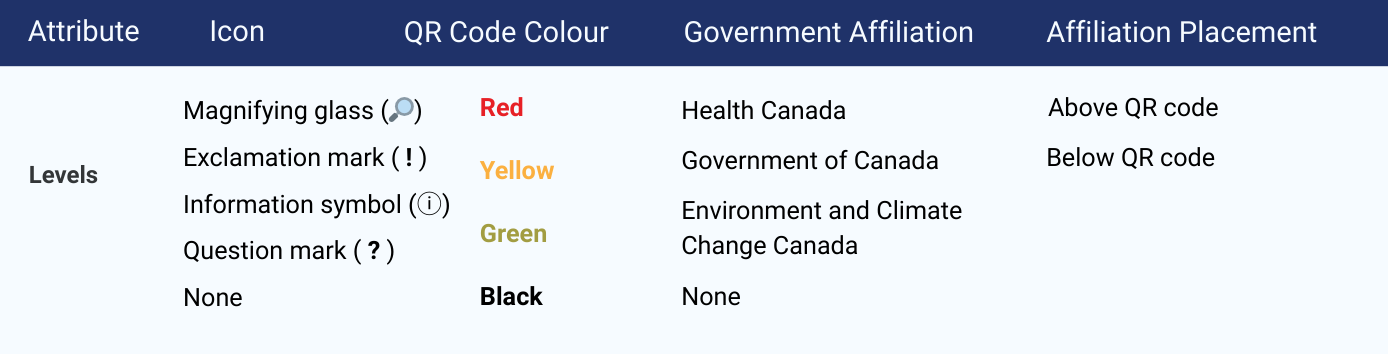
Participants then completed a discrete choice experiment that explored which features made a QR code more appealing to scan. A discrete choice experiment provides rich data on participants’ preferences by asking them to make a series of choices between multiple products or services that vary in their attributes. These data are then analyzed to reveal the extent to which each attribute, and each level within, is important to participants. Discrete choice analysis goes a step beyond self-reported preference typically asked in surveys. We created a set of QR codes that varied in four ways—colour, government affiliation, the placement of the affiliation, and an icon (see Table 1). This produced 140 unique QR codes. Each participant viewed 10 randomly selected pairs of QR codes, and for each pair, were asked to choose the option they would be most likely to scan (see Figure 1).
This study and its analysis plan were pre-registered on the OECD Observatory of Public Sector Innovation Behavioural Insights Knowledge Hub prior to completing data collection.
Table 1. Attributes and levels of the attributes used to make the different QR codes. This resulted in the creation of 140 QR codes.
-
Text version
Attribute Icon QR Code Colour Government Affiliation Affiliation Placement LEVELS Magnifying glass Red Health Canada Above QR code Exclamation mark Yellow Government of Canada Below QR code Information symbol Green Environment and Climate Change Canada Question mark Black None
Figure 1. Sample task in the discrete choice experiment.

-
Text version
The left image depicts a red QR code with the magnifying glass icon and a Government of Canada affiliation placed above the QR code. The right image shows a green QR code with a question mark icon and a Health Canada affiliation placed below the QR code.
Image headline: "Between the two options shown, please select the QR code that you would be most likely to scan to obtain more product information".
Findings
QR code use is low relative to awareness
Participants reported using QR codes in many different settings, and for many purposes. For example, to access restaurant menus, board flights, enter concert venue, or download mobile applications. Finding ways to drive curiosity and alleviate possible security concerns could help increase scanning rates.
Given their broad range of use, it is no surprise that almost everyone (90%) reported familiarity with QR codes. Awareness of QR codes for purpose-driven uses was highest (e.g., to view menus [62%], or download mobile applications [57%]). Despite high levels of knowledge and awareness, reported QR use was generally low; only 22% of participants said that they always or frequently scanned QR codes. More curious individuals and those with higher levels of education more frequently scanned QR codes, whereas women and older adults reported scanning them less frequently. Participants cited a lack of interest in the linked content (33%) and security concerns (31%) as top reasons for not scanning QR codes.
Less than half the participants read product labels regularly
Preferences for physical labels may be a barrier to widespread engagement with digital product labels. Nearly half (46%) of respondents preferred physical product labels over digital labels. About a fifth (17%) preferred digital labels alone, 18% preferred a combination of physical and digital labels, and 20% has no preference.
Less than half of Canadians (40%) reported always or frequently reading these labels, but most participants (71%) reported being influenced by the information they contained when they did read them. Of the many kinds of information on product labels, participants were most interested in the price (72%), followed by health information, including ingredients (68%) and nutritional information (61%). Designing labels that contain information that consumers find relevant may better inform their purchasing decisions.
Colour and government affiliation were the most preferred QR code attributes
Many different design features contribute to the appearance of a QR code. These features shape the code’s appeal for consumers, and the likelihood that they will scan it. We investigated four QR code design attributes (colour, government affiliation, affiliation placement, icon) to understand their influence on consumer scanning intention.
Of the attributes tested, colour had the largest influence on scanning intention, with black being the most preferred colour (see Figure 2 and Figure 3). The next most impactful attribute was government affiliation; QR codes with any government affiliation were preferred to those with no affiliation. Of the government affiliations tested, Health Canada was the most influential. The placement of the affiliation and the kind of icon (e.g., question mark) had the least influence on scanning intention, with a small preference for no icon at all or a magnifying glass.
The preference for black QR codes may relate to the prevalence of such codes driving familiarity, or the cultural associations that other colours may have. A government affiliation may also convey credibility and ease security concerns. Together, these preferences reveal a desire for neutrality in the design features of the QR code.
Figure 3. The top tested QR code.
Of all feature combinations tested, a black QR code, with a Health Canada affiliation above and a magnifying glass in the centre, was the most likely to be scanned. It is important to note that this top QR code captures joint effects that are not present in Figure 2, where all other features are held constant.

Discussion
Sharing product information in a salient and effective manner empowers Canadians to purchase products that are safer for themselves and the environment. Findings from this study will help governments understand and appropriately account for the preferences and behaviours of Canadians, as they prepare to implement more widespread use of digital technologies for consumer product information, including hidden drivers and barriers to engagement. For instance, Canadians’ preference for physical labels over digital, concerns about security, and a more general lack of interest in QR codes are key barriers that risk undermining the successful implementation of digital-forward product labels.
There are a number of different approaches that have the potential to address these behavioural barriers, and improve the likelihood of successful implementation. For example, pairing digital labels with visually engaging physical labels may leverage curiosity as a driver, and mitigate the preference for physical-only labels. Clear security safeguards, endorsement by trusted government actors, and the standardized presentation of product information in the linked resource are likely to increase both scanning intention and trust in the information being disclosed. Ensuring that labels contain the information that consumers want most may encourage them to engage with other information on the labels and linked resources, and contributing to more informed purchasing decisions.
Overall, these findings suggest that the specific characteristics of digital labels are important for their success, and that their combination with physical labels with which Canadians are more familiar and comfortable, may help overcome behavioural barriers and leverage drivers like curiosity. User testing will be important for ensuring that the physical labels and digital resources are appropriately designed and interact well to drive regular consumer engagement with the QR codes they find on everyday items.
For Further Information
To learn more about this project or other Impact and Innovation Unit activities, please contact the team at iiu-uii@pco-bcp.gc.ca.
Acknowledgements
The Program of Applied Research on Climate Action and the Environment (PARCA) is a partnership between the Privy Council Office’s Impact Canada, Environment and Climate Change Canada and Natural Resources Canada. PARCA is a multi-year program of research that combines behavioural science insights and methods with robust policy analysis to promote climate action.
This research was conducted by Impact Canada staff. The study received ethical clearance from the Veritas Independent Review Board (Tracking Number 2024-3481-17289-2).
Kashdan, T. B., Disabato, D. J., Goodman, F. R., & McKnight, P. E. (2020). The Five-Dimensional Curiosity Scale Revised (5DCR): Briefer subscales while separating overt and covert social curiosity. Personality and individual differences, 157, 109836.
Library and Archives Canada Cataloguing in Publication
Testing QR Code Designs
Information contained in this publication or product may be reproduced, in part or in whole, and by any means, for personal or public non-commercial purposes without charge or further permission, unless otherwise specified. Commercial reproduction and distribution are prohibited except with written permission from the Privy Council Office.
For more information, contact:
Impact Canada, Privy Council Office
85 Sparks Street, Room 1000
Ottawa ON Canada K1A 0A3
info@pco-bcp.gc.ca
© His Majesty the King in Right of Canada, 2024.
Cette publication est également disponible en français : Mise à l’essai de designs de codes QR
ISBN:
ISBN: 978-0-660-76715-4
CP22-232/2025E-PDF