The AMR Innovation Pilot
Improving access to priority antimicrobial drugs for people in Canada through innovative, outcomes-based incentives.
Introduction
Stay Informed About the AMR Innovation Pilot
The AMR Innovation Pilot is anticipated to launch for application submissions in late fall 2026, with details on the funding to be announced in the coming months. Announcements and updates will be posted on this page.
If you are interested in receiving updates about the AMR Innovation Pilot, you can register your interest by signing up.
To help address the growing threat of antimicrobial resistance (AMR), the Public Health Agency of Canada (PHAC) and Impact Canada are partnering to deliver the Antimicrobial Economic Pull Incentives Pilot Project (AMR Innovation Pilot).
The AMR Innovation Pilot is a time-limited, first-of-its-kind approach in Canada that is designed to introduce innovative, outcomes-based financing mechanisms to address the market challenges that limit the availability of new antimicrobial drugs.
The AMR Innovation Pilot uses targeted economic incentives to help improve access to antimicrobial drugs that meet priority and unmet public health needs for people in Canada. The focus of the pilot is on high priority antimicrobials needed in the hospital setting for the treatment of complex healthcare associated infections due to multi-drug-resistant organisms. The incentives include supports that are intended to make the marketplace more attractive for companies responsible for antimicrobial drugs. The AMR Innovation Pilot also aims to encourage antimicrobial stewardship practices.
PHAC’s partnership with Impact Canada enables the AMR Innovation Pilot to adopt an outcomes-based financing approach. Outcomes-based financing shifts the focus from paying for activities to paying for outcomes and impact, where payments are issued to successful applicants when clear pre-determined outcomes have been accomplished. Impact Canada helps partners like PHAC to execute outcomes-based financing initiatives that reward the delivery of solutions to problems that matter to Canadians, including AMR.
Why Canada needs new antimicrobial drugs
AMR occurs when microbes evolve in ways that reduce the effectiveness of the medications used to fight infections. When resistance to antimicrobials increases, it becomes more difficult to treat common and minor infections successfully. When an infection can't be treated effectively with an antimicrobial drug, the risk of severe illness, even death, increases.
AMR is a global problem and countries around the world are working together to mitigate and respond to its impacts. Here in Canada, AMR is a serious and growing threat. In 2018 alone, it was estimated that AMR contributed to about 5,400 deaths. Current efforts to develop new antimicrobials are not sufficient to address the health care needs in Canada and around the world.
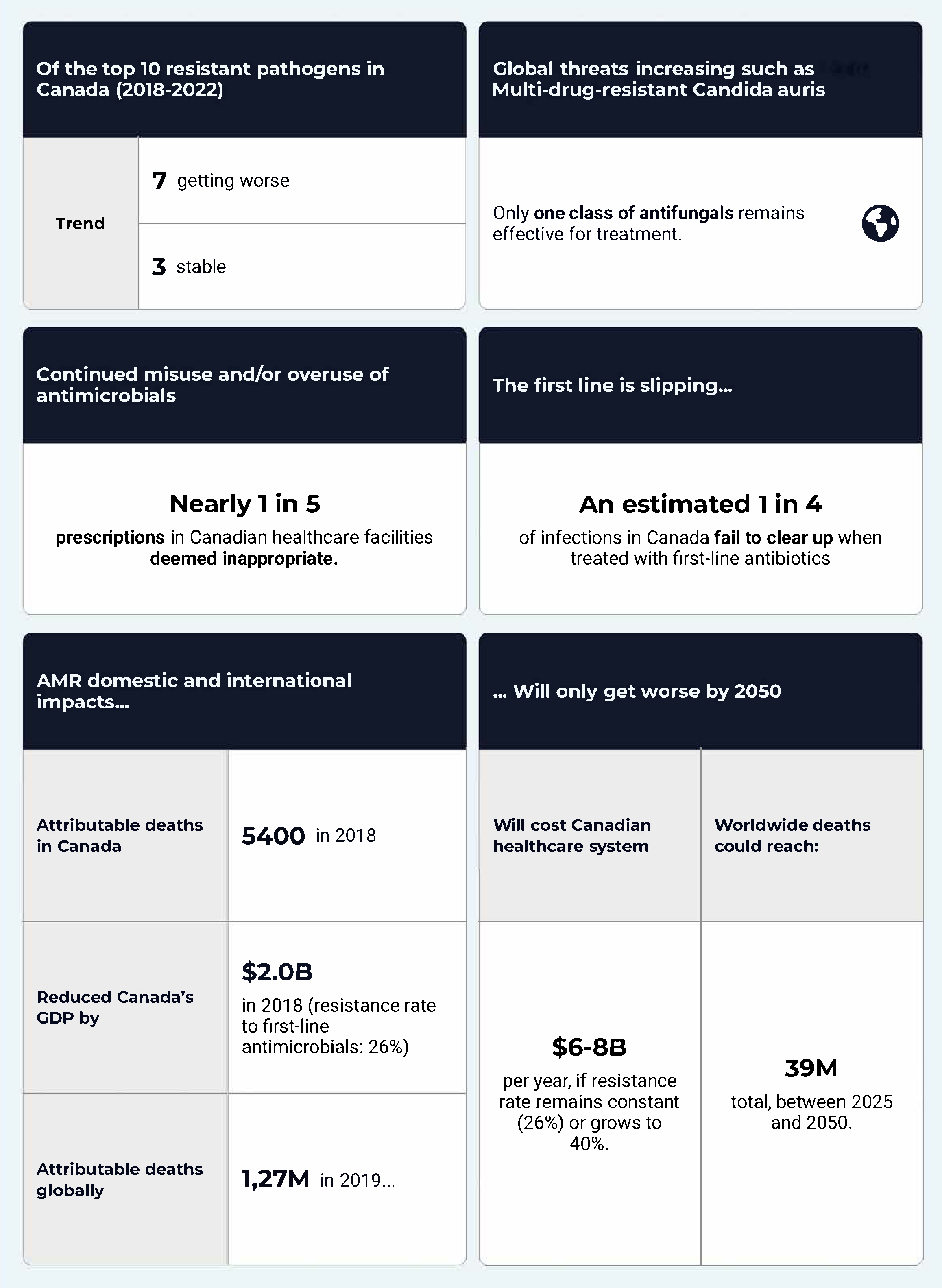
Figure - Text description
| Of the top 10 resistant pathogens in Canada (2018-2022) | Global threats increasing such as Multi-drug-resistant Candidauris | Continued misuse and/or overuse of antimicrobials | The first line is slipping... | |
|---|---|---|---|---|
| Trend: 7 Getting Worse | Trend: 3 Stable | Only one class of antifungals remains effective for treatment. | Nearly 1 in 5 prescriptions in Canadian healthcare facilities deemed inappropriate. | An estimated 1 in 4 of infections in Canada fail to clear up when treated with first-line antibiotics. |
| Attributable deaths in Canada | Reduced Canada's GDP By | Attributable Deaths Globally |
|---|---|---|
| 5,400 in 2018 | $2.0 billion in 2018 (resistance rate to first-line antimicrobials: 26%) | 1.27 million in 2019 |
| Will cost Canadian healthcare system | Worldwide deaths could reach |
|---|---|
| $6-8 billion per year, if resistance rate remains constant (26%) or grows to 40% | 39 million total, between 2025 and 2050 |
The time and cost required to bring a product to market in any country are key considerations for companies seeking regulatory approval. In Canada, the small population size and complex health care system further limit potential returns, making market entry even more difficult. Because of these and other challenges, fewer than half (8 out of 23) of the antimicrobial drugs developed worldwide since 2010 are available to patients in Canada.
The Government of Canada is committed to combatting AMR and securing access to new effective antimicrobials. The 5-year Pan-Canadian Action Plan on AMR (2023 to 2027) sets out a coordinated, multisectoral and multijurisdictional approach to addressing AMR in Canada. In Budget 2023, the government committed to developing a pilot project to help secure access to new antimicrobials for people in Canada. PHAC is leading this initiative, with support from Health Canada and Impact Canada. As part of this initiative, PHAC is consulting with provincial and territorial partners, international stakeholders, industry stakeholders, and health professionals, including clinical experts.
To learn more about AMR, the Government of Canada's response, the development of the AMR Innovation Pilot, international approaches to incentivizing access to new antimicrobials, and Canada's role in global AMR research and development efforts, please visit PHAC's website “Innovation pilot to improve access to antimicrobials in Canada.”
More about the AMR Innovation Pilot
The AMR Innovation Pilot is designed to improve access to priority antimicrobial drugs and address public health needs through an innovative pull incentive mechanism. Through an outcomes-based financing model, companies receive economic incentives for achieving specific, measurable outcomes that directly enhance access to these critical treatments in Canada. Canada is one of only a small number of countries advancing innovative financial incentives to address AMR and improve access to critical life-saving treatments.
The AMR Innovation Pilot aims to:
- improve access to priority antimicrobial drugs not currently marketed in Canada
- encourage market entry in Canada by providing incentives that align with public health needs
- support measurable outcomes through clear performance expectations and reporting requirements
PHAC is partnering with Impact Canada to implement an outcomes-based financing approach. Impact Canada has expertise in designing and delivering initiatives focused on measurable results. It uses dedicated authorities and a structured methodology to:
- design and deliver innovative programs
- support outcomes-based financing models
- apply rigorous performance measurement
- engage strategically with partners and stakeholders
As part of the Pilot’s design process, PHAC and Impact Canada will establish:
- eligibility requirements for participation
- assessment criteria for evaluating proposals
- a pay-for-results structure with measurable deliverables that the successful applicants will be expected to achieve
- an independent jury of subject matter experts to assess proposals and deliverables and provide recommendations to the Minister of Health.
During summer 2026, PHAC, with support from Impact Canada, will engage stakeholders and subject matter experts to validate elements of the Pilot's design.
Summer 2026 update: Pilot design and stakeholder engagement
Throughout summer 2026, PHAC and Impact Canada have continued to engage with a diverse range of stakeholders and subject matter experts to inform and validate key elements of the Pilot's design.
This engagement has included two industry sessions facilitated by the Canadian Antimicrobial Innovation Coalition (CAIC) on July 15 and August 12, 2026. These sessions provided opportunities to share updates on the Pilot's development, gather feedback and hear directly from industry stakeholders.
PHAC and Impact Canada are also inviting interested industry stakeholders to participate in bilateral meetings to provide further feedback and ask questions about the Pilot design.
Industry stakeholders — particularly organizations considering applying to the Pilot — are encouraged to contact AMR.pilot-pilote.RAM@phac-aspc.gc.ca to request and schedule a bilateral meeting to take place before September 8, 2026.