The Challenge of Saving Food from Going to Waste
Impact Canada, Impact & Innovation Unit, Privy Council Office
When the COVID-19 crisis hit in March 2020, and as Canada was heading into its first lockdown, like many of my fellow citizens I quickly ran to the supermarket to stock up on food essentials. While true that toilet paper became the most notoriously coveted good, food items were the principal prey to panic buying, leaving scores of empty shelves in stores. Food security was under threat in Canada: fears of global supply chains disruptions and panic buying had reduced the amount of food being donated to food banks. Meanwhile, thousands of vulnerable Canadians had lost their incomes and were seeking more support to feed their families.
At that time, I was an Impact Canada Fellow embedded at Agriculture and Agri-Food Canada (AAFC), working to support the department in designing a challenge competition to reduce food waste. Needless to say that it could have sounded absurd at the time to talk about food being wasted while the country was grappling with fears of food insecurity. However, it became quickly apparent that food waste and food security were just two different aspects of the same coin and that addressing both would be necessary to build a reliable and robust food system.
In fact, contrary to toilet paper (of which some people might still have industrial-level quantities hoarded in their homes), food items have a limited shelf life and bulk buying is a main reason for household food waste as food may spoil before being consumed. Nonetheless, food waste is not limited at the household level and is a concern at all levels of the food value chain from farm to fork. But most of the food waste up the value chain (such as unharvested fruits and vegetables, undersized or non-standard crops, produce bruised or damaged during transportation or processing, or excess inventory in retail or food service), is referred to as “food loss” and is most generally considered as “business losses” or just the cost of doing business. So in order to address food waste, we need to reinvent how we do business as usual to maximize the value of food and make food available to Canadians while boosting the competitiveness of agri-businesses.
When I was selected as an Impact Canada Fellow at AAFC, I did not know much about the problem of food waste and I was wondering whether I would be of value to the department in designing a program addressing a topic I had little knowledge about. That concern vanished quickly as soon as I joined AAFC as it turned out that this expertise and knowledge was already there, dispersed across many experts, scientists, and officials at the department, and was thus not requested from me. My role was to support the department in capturing that expertise into the challenge design process and to guide them through this process. For that role I was very well equipped: I had significant training in the design thinking process, as well as practical expertise in the design and implementation of outcomes-based programs.
Role of the Fellow in the Challenge Design Process
As a fellow, I did not just advise on the process of designing and implementing a challenge program, but I was also aiding in all the operational pieces that were necessary to bring the program to life. I first participated in founding the team and building its capacity to design and implement challenges. I participated in the intensive stakeholder engagement exercise that is necessary to understand the problem of food waste. And indeed the power of the design process, and the understand phase in particular, is that even when starting with little knowledge of the problem, one develops sufficient understanding and appreciation of the problem to be able to draft a design prototype. We tested that prototype with more than 40 diverse innovators and stakeholders before we had a program design that was ready to be approved.
Policy work was also part of my fellowship role, as I helped the department in grounding the program with a strong policy underpinning and in navigating the policy implications of different new developments such as the COVID-19 crisis and its effect on food security and food waste. The design process and in particular the intensive stakeholder engagement exercise allowed me to support the department in setting up a compelling conceptual framework for the challenge by defining the problem over two dimensions:
- Level of readiness of solutions: This dimension helped us to consider in our challenge design both solutions that are at the experimental stage (ideation and prototyping) and solutions that are at commercialization stage and are ready to go to market. The result was the definition of two types of streams within the challenge: one focused on supporting the development and advancement of new technologies and another focused on supporting the deployment of new and innovative business models.
- Food waste reduction strategies: The initial thinking when we first started designing the challenge is that we needed to look at solutions from a sectoral perspective (for example, solutions for restaurants or solutions for supermarkets). However, through our design work, we understood that to reinvent the food system, it is important to look at the interconnections between the different segments/sectors of the food supply chain and to even encourage solutions that have more systemic and holistic approaches. For that purpose, we took a step back and defined the types of solutions in terms of strategies: solutions that seek to prevent food waste (i.e. stop the generation/creation of food waste) and solutions that seek to divert food waste (i.e. recreate value from food that is going to waste).
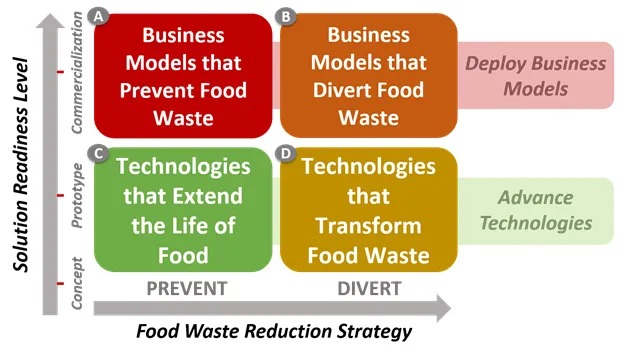
Text version
Challenge Stream A: Business models that prevent food waste. Challenge Stream B: Business models that divert food waste, food by-products and/or surplus food. Challenge Stream C: Technologies that Extend the Life of Food. Challenge Stream D: Technologies that Transform Food Waste.
In addition to a compelling design, for a challenge to be successful, it needs to be accompanied by an intensive innovator outreach campaign. This is why, as a fellow, I was heavily engaged in supporting AAFC in the design and implementation of an effective outreach campaign to attract new talent who would take on the challenge and submit their ideas and solutions. Using data science, we analyzed on a weekly basis the effectiveness of our campaign, looking at different indicators including website page views trends and social media analytics to adjust our approach.
The challenge design and innovator outreach campaign led to successful results for the challenge. Just in its first round, the Food Waste Reduction Challenge exceeded the record of any other challenge in terms of number of applications, and over its two rounds it received a total of 589 applications. Finally, the challenge was successful in attracting a very diverse pool of talent to solve the problem of food waste:
- More than 1 in 10 applicants were individuals with a new idea, planning to create a new business or a not-for-profit.
- And 60% had not applied to any government funding in the past 5 years.
International applicants from 25 countries
- 20% Youth (30 years old and under)
- 25% visible minority groups
- 32% Women or Women-Led Businesses