
Smart Cities Challenge
A new way the Government of Canada is helping communities become healthier, more inclusive and liveable
Introduction
The results are in!
Transcript
Canada's Smart Cities Challenge
The Smart Cities Challenge called on communities across Canada to come up with solutions to their most pressing issues.
Using data and connected technology with inspiring and scalable innovations that are available to everyone.
Communities told us what matters:
- Mobility
- Health
- Safety
- Housing
- Well-being
Canada's unique approach:
- Resident-driven ideas
- Inclusive of all communities
- Widely shared solutions
Winners announced in May 2019.
Prizes totaling $75M.
Follow their journey!
#smartcitiesCanada
Communities lead the way
The Smart Cities Challenge is a competition open to all municipalities, local or regional governments, and Indigenous communities (First Nations, Inuit, and Métis) across Canada.
This Challenge will empower communities across the country to address local issues their residents face through new partnerships, using a smart cities approach.
A smart cities approach means achieving meaningful outcomes for residents through the use of data and connected technology. This approach can be adopted by any community, big or small.
Finalists will receive support to develop their smart cities proposals. Winning communities will be awarded with prize money to help implement them.
Through the Smart Cities Challenge, we hope to:

Realize outcomes for residents
Because the Smart Cities Challenge is all about achieving outcomes, it will be vital for communities to measure where they are starting from, when they are making progress, and when they have achieved success. Establishing a baseline and measuring results will be central to doing this.

Empower communities to innovate
Communities should take risks and think big, identify significant, pressing, and perceived “un-solvable” problems, and achieve outcomes through data and connected technology.

Forge new partnerships and networks
Communities will need to undertake meaningful engagement with residents and forge relationships with new and non-traditional partners.

Spread the benefit to all Canadians
Smart cities approaches should not only benefit a single community; they should be scalable and replicable across Canada.
The Challenge Statement
To begin, each community will define its Challenge Statement.
The Challenge Statement is a single sentence that defines the outcome or outcomes a community aims to achieve by implementing its smart cities proposal. The Challenge Statement must be measurable, ambitious, and achievable through the proposed use of data and connected technology. Below, for illustrative purposes only, are examples of Challenge Statements. Please refer to the Applicant Guide for further details on these Statements which include ideas on the kinds of smart cities activities or projects that could address them and indicators on how progress might be measured.

Feel safe and secure
The neighbourhood in our community with the highest crime rate will become safer than the national average.

Earn a good living
After years of decline, our community will transform a former industrial neighbourhood into one of the top locations in Canada for economic growth.

Move around my community
Our community will ensure that every senior who is able to live independently at home is empowered to do so.

Enjoy a healthy environment
Our community will implement preventative measures to reduce flood damage risk by 40 percent and provide every resident of at-risk areas with access to these measures.

Be empowered and included in society
Our community will ensure that every person without a home has access to nightly shelter, and will connect 100 percent of vulnerable residents with the services, activities and programs that are known to reduce the risk of homelessness.

Live an active and healthy life
Our community will become 50 percent more active and healthy, and achieve a measurable decrease in chronic disease.
The Challenge
Smart Cities Challenge: a new kind of initiative
The Smart Cities Challenge is a new way the Government of Canada is helping communities become healthier, more inclusive and liveable.
By challenging communities to use data and connected technologies to address their most pressing problems, the Smart Cities Challenge is encouraging innovation through:
Competition
There is nothing like friendly Canadian rivalry to motivate communities to collaborate towards a common goal. The Challenge has meaningful prizes and a strong incentive to win.
Transparency
Competing communities will share their ideas publically after submitting their applications. This transparency will encourage residents, decision-makers, private and public sector institutions across Canada to be inspired by the ideas and accomplishments of others.
Outcomes
The Challenge is about solving issues that matter to residents. Winning proposals will be those that identify the most compelling, meaningful outcomes and set measurable and ambitious milestones to achieve them.
Experimentation
The Challenge encourages communities to try new approaches, evaluate progress as they go, and make course corrections as needed.
Inclusiveness
With prize categories for communities of all sizes, all Canadian communities have the opportunity to participate. The Challenge’s jury members, who will select finalists and winners, will come from diverse backgrounds, regions and perspectives. Challenge finalists and winners will be representative of Canada’s diverse communities.
Empowerment
The Challenge will benefit all communities who compete, whether they win or not. By engaging residents, developing proposals, and building partnerships, communities will learn throughout the competition process. Communities that make it to the finalist stage will be supported by a $250,000 grant to develop their final proposals.
Knowledge-Sharing
The knowledge and ideas created from this competition will be shared beyond participants and winners, so that communities across the country can benefit. Proposals and best practices will be posted online, and community leaders, residents, private and public sector stakeholders will have a chance to network, engage and share ideas through various platforms.
What is a smart cities approach?
A smart cities approach aims to achieve meaningful outcomes for residents by leveraging the fundamental benefits that data and connected technology have to offer:
Openness
When communities make their data truly accessible, usable and barrier-free, their decision-making processes become transparent, empowering citizens and strengthening the relationship between residents and public organizations.
Integration
Data and connected technology empower communities to break down silos that exist within local governments and public organizations.
Transferability
When tools and technological approaches are open-source, transparent and standardized, they can be used by communities across the country, no matter their size or capacity.
Collaboration
Connected technology enables communities to bring traditional and non-traditional partners together to collaborate.
Who can apply?
The Smart Cities Challenge is open to communities of all sizes across Canada. Applicants must represent an identifiable community and must be responsible for services in that community.
The following organizations can participate in the Smart Cities Challenge:
- Municipalities and local or regional governments established by or under provincial or territorial statute.
- Indigenous communities including First Nations, Inuit, and Métis communities (such as First Nation band and Tribal Councils, and communities under Self-Government Agreement, Comprehensive Land Claim Agreement or the Métis nation).
- A combination of organizations listed above.
A community or a group of communities can only submit one application in this competition.
Communities that intend to apply are encouraged to contact Infrastructure Canada early on to confirm their eligibility.
Selection of finalists and winners
Infrastructure Canada is currently looking for jury members for the Smart Cities Challenge. Interested individuals can apply on the Infrastructure Canada website.
The Jury will be comprised of accomplished individuals from across the country who are publicly recognized in their field, have a strong track record of leadership, and have a demonstrated interest in public issues or public service. Infrastructure Canada will strive to reflect gender parity and the diversity of the Canadian population in the Jury composition.
Finalists and winners will be determined by a panel of jury members.
Jury members will be selected by the Minister of Infrastructure and Communities.
Process
Communities are encouraged to contact Infrastructure Canada with any questions regarding the process.
Infrastructure Canada is engaging Indigenous leaders, communities and organizations to finalize the design of a competition specific to Indigenous communities that will reflect their unique realities and issues. Indigenous communities are also eligible to compete for all the prizes in the current competition using the process and timelines outlined on this site and in the Applicant Guide.
Application
APPLICATION SUBMISSION DEADLINE – April 24, 2018
Applicants should begin the Smart Cities Challenge process by engaging with residents about the most pressing issues their community faces. These consultations will help applicants define their Challenge Statements.
With their Challenge Statements established, applicants will develop the ideas and activities that will make up their preliminary Smart Cities Challenge proposal. The questions that will appear in the application form, information on how to fill it out, and evaluation criteria are provided in the Applicant Guide, available for download on this website.
Applicants must complete and submit their applications on this website by April 24, 2018.
Applicants are encouraged to contact Infrastructure Canada with questions about eligibility and other application requirements prior to the deadline.
When appropriate, questions asked and answered will be made available on this website.
Selection of Finalists
FINALIST ANNOUNCEMENT – Summer 2018
Once applications are screened for eligibility, Infrastructure Canada will post the summaries on this website. Applicants will post the full versions online.
Eligible applications will be reviewed by experts from inside and outside government and will then be evaluated by an independent Jury.
The Jury will select finalists by Summer 2018. Each of these finalists will receive a $250,000 grant to develop their final proposal.
Final Proposal
FINAL PROPOSAL SUBMISSION DEADLINE – Winter 2019
Finalists will develop fully-implementable final proposals that outline all design, planning, and project management components of their plans. Each final proposal must present a strong business case with clearly established milestones and measurable outcomes. Finalists will also outline their data and reporting strategy, making appropriate links to Infrastructure Canada's Climate Lens and Community Benefits Reporting Framework. The Climate Lens will only apply to proposals related to climate change mitigation and climate change adaptation.
As they develop their final proposals, finalists will also formalize partnerships with organizations that will help them implement their projects, and will establish project governance structures.
These final proposals are due in Winter 2019. The deadline and evaluation criteria for final proposals will be made public at the time of the announcement of finalists.
Selection of Winners
WINNER ANNOUNCEMENT – Spring 2019
Infrastructure Canada will post all final proposals on this website.
Similar to the preliminary applications, final proposals will be reviewed by experts and then evaluated by the Jury. Their evaluations will focus on project feasibility, strength of the business case, and clear links to the outcomes established in the Challenge Statement.
The Jury will select winners by Spring 2019.
Implementation
Winners will receive prize money through contribution agreements with Infrastructure Canada. Payments will be made once projects attain milestones that demonstrate progress towards outcomes.
Throughout implementation, winners will maintain close contact with Infrastructure Canada. Winners will continually monitor their progress and, if course corrections are necessary, they will work with Infrastructure Canada to make them.
Depending on the nature and scope of the final proposal, implementation is expected to span between 2-5 years.
Lessons learned from the entire Smart Cities Challenge process will be gathered from all participants and shared with Canadian communities.
Prizes
$50M
One prize of up to $50 million
Open to all communities, regardless of population.
$10M
Two prizes of up to $10 million each
Open to all communities with populations under 500,000 people. Footnote 1
$5M
One prize of up to $5 million
Open to all communities with populations under 30,000 people. Footnote 1
Infrastructure Canada is engaging Indigenous leaders, communities and organizations to finalize the design of a competition specific to Indigenous communities that will reflect their unique realities and issues. Indigenous communities are also eligible to compete for all the prizes in the current competition.
All finalists will receive a grant of $250,000 to develop their final proposal.
Prize money will be awarded through contribution agreements with Infrastructure Canada.
Applicants are encouraged to solicit additional funds from other resources to strengthen the impact and reach of their proposals.
Applicants who do not win one competition can submit a new or improved application to subsequent competitions.
The Smart Cities Challenge includes three competitions, the first one wrapping up in the Spring of 2019.
Results
Transcript
Canada's Smart Cities Challenge, The Winners
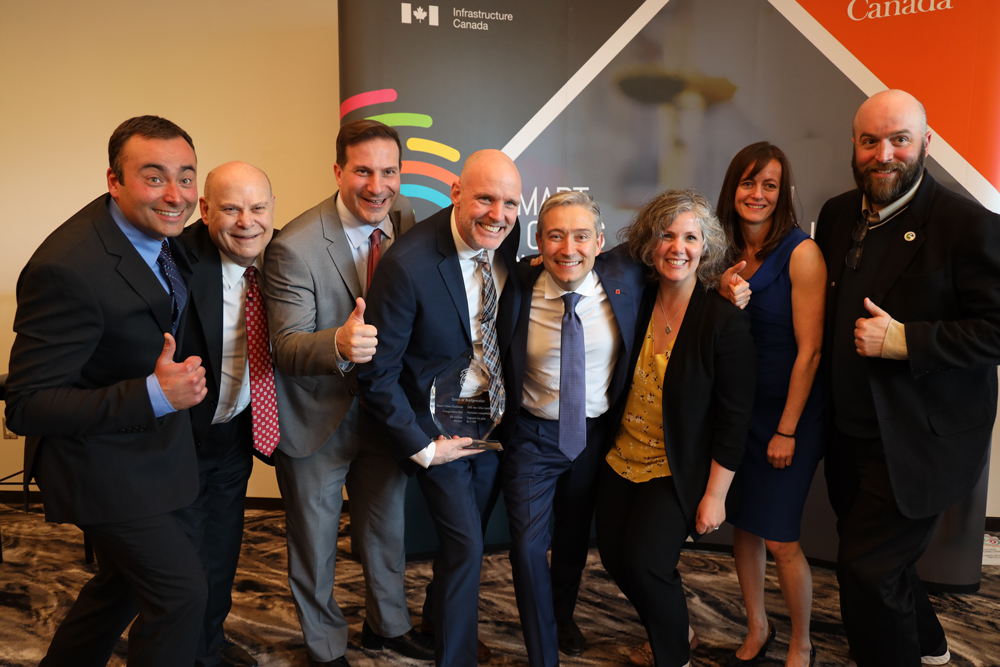
Town of Bridgewater, Nova Scotia ($5M): Reduction of energy poverty
Leon De Vreede, Sustainability Planner, Town of Bridgewater:
Energy poverty is when people spend more than 10% of their available income on energy for their home and for their means of transportation.
David Mitchell, Mayor of Bridgewater:
Through community engagement, consultation and research we determined that 40% of our people were living in energy poverty. Recognizing that so many were facing this hardship, we set about finding innovative solutions to solve this issue and lift our citizens out of this crippling cycle. Those solutions became our Smart Cities Challenge winning plan called Energize Bridgewater. Through home retrofits and improvements we will begin the first phase of this plan, reducing their energy costs and carbon footprint all at the same time.
Leon De Vreede:
The core of our program is to implement an energy management information system. Those most vulnerable, who are lacking access to energy resources already are actually helped first into a more sustainable, more resilient energy future.
Nunavut Communities, Nunavut ($10M): Community connectivity, and digital access for life promotion
Ryan Oliver, Director and Founder of Pinnguaq:
Our vision for the Smart Cities project is to create a series of maker spaces to make available infrastructure to promote and enable tech learning but also to build resiliency and build positive health outcomes and the ability to just explore in a space what a community wants to explore.
Taha Tabish, Health Technology Innovations Research Coordinator, Quajigiartiit Health Research Centre:
Our Inuit traditional values, you know sort of talk about, building capable human beings. The gap that exists in sort of high-speed high-bandwidth Internet for rural and remote communities I think sort of translates into an inability to engage with not just the rest of Canada, but I think also the rest of the world.
It's about strengthening community bond. It's about allowing young people to feel sort of, agency of self and to connect with their culture, to connect with their identity and feel proud of that and to learn skills and feel like they're part of something bigger than themselves.
City of Guelph and Wellington County, Ontario ($10M): A circular food economy
Cathy Kennedy, Manager, Policy and Intergovernmental Relations City of Guelph:
In Guelph-Wellington we are working to create a regional eco-food system bringing together farmers and researchers and entrepreneurs to create solutions to solve food problems.
Barbara Swartzentruber, Executive Director, Smart Cities Office:
So we're working with our partners from multiple sectors on three goals. That's to increase access to affordable nutritious food, to create new circular businesses and collaborations, and to increase the economic and social value by transforming waste.
Cathy Kennedy:
We know in Guelph-Wellington that one out of six families are food insecure. We also know that we waste approximately thirty to fifty percent of our food. That is simply not sustainable. So we are creating a regional eco food system where everybody will have access to affordable nutritious food, where nothing is wasted and where we can create economic opportunities by creating new businesses and collaborations.
City of Montréal, Quebec ($50M): Mobility and access to food
François Croteau, Lead, Smart Cities, City of Montréal:
In order to identify the priority projects for the city of Montréal as part of the federal Smart Cities Challenge, the City of Montréal decided to invite the community citizens and organizations alike to a daylong brainstorming session to determine which projects were priorities for the community. During the day of collaboration and consultation, two important, significant projects were identified as being priorities for the community.
First, an integrated mobility project was identified. A neighbourhood mobility project aimed at improving mobility in neighbourhoods in close proximity to one another. Through a misture of transportation and shared data, so that we can improve things and help people who depend on solo car use to more easily get around their neighbourhoods.
Second, we identified issues involving access to food, combatting food desserts and ensuring that people who depend on solo car use can have access to both easier mobility and to quality food via distribution networks that are also linked to open, shared data.
Therefore, the objective of this project, of course, will be to experiment. Experiment within one neighbourhood, then several neighbourhoods, and to invite the population to participate in this project. This could make it possible to expand the project throughout not only the City of Montréal, but also throughout the Montréal Metropolitan Community, and ultimately transform our big, beautiful city.
#smartcitiesCanada
Winners Announcement
May 14, 2019
The winners were announced on May 14, 2019.
Final Proposals
March 22, 2019
All 20 finalists have submitted their final proposals and videos. The winners will be announced on May 14, 2019.
Click here to read the final proposals and view the finalist videos.
Spotlight on Finalists
June 1, 2018
The following is a spotlight on finalists, who were announced on June 1, 2018.
Dashboard
June 1, 2018
The following is a dashboard that shows some high-level analysis of the applications that were submitted in April 2018 for the first competition.
Participating Communities
June 1, 2018
The Smart Cities Challenge application deadline was April 24, 2018. Communities, large and small, from all over Canada have submitted applications with their bold, innovative ideas.
The following is an interactive map and table of the applicants and the 20 finalists, who were announced on June 1, 2018. Click on the icons on the map and the buttons in the table to see more information.
Stay connected
The Smart Cities Challenge Team has been receiving some questions. Check out the Frequently Asked Questions (FAQ) which are updated regularly.
Applicants are encouraged to contact Infrastructure Canada early in the process of developing their applications to ask questions and ensure they are on the right track. When appropriate, questions asked and answers provided will be available on this website.
Follow the Smart Cities Challenge on Twitter and Facebook to get the latest news about the Smart Cities Challenge. To join the conversation on smart cities, use #smartcitiesCanada on Twitter.
To learn more about how the Smart Cities Challenge advances the Investing in Canada Plan as well as about Infrastructure Canada and its other programs, visit the Infrastructure Canada site.
Smart Cities Challenge
Email: sc-vi@infc.gc.ca
Infrastructure Canada Public Enquiries
- Phone: 613-948-1148
- Toll free: 1-877-250-7154
- Email: infc.info.infc@canada.ca
Infrastructure Canada Media Relations
- Phone: 613-960-9251
- Email: infc.media.infc@canada.ca
Apply
Who can apply?
- Municipalities, local or regional governments
- Indigenous communities
- Groups of organisations above
Key dates
- Application deadline: April 24, 2018
- Announcement of finalists: Summer 2018
- Announcement of winners: Spring 2019
Prizes
- One prize of up to $50 million
- Two prizes of up to $10 million each
- One prize of up to $5 million
Media





Last modified: 2026-04-27